
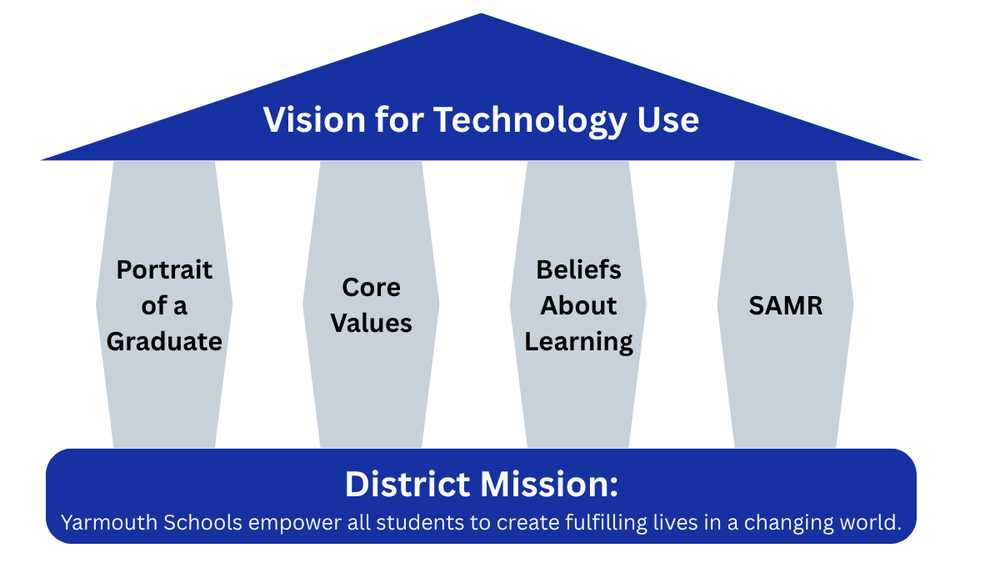
The Yarmouth School Department is excited to roll out a new "Vision for Technology Use," along with a customized "Screen-Use Framework" for each school in the district!
Heather Manchester, Assistant Superintendent for Teaching and Learning, and Mike Arsenault, Director of Technology, introduced these new resources to the community at the Parent School Alliance meeting on November 10 at Yarmouth Elementary School.
The goal of the new framework is to help students and teachers build healthy habits by balancing digital tools with offline learning. We encourage all families to review the guidelines as we work together to support our students' tech journey at school and at home!
Yarmouth School Department
Vision of Technology Use in Our Schools
To empower all students to create fulfilling lives in a changing world, the Yarmouth School Department uses technology intentionally to deepen learning, expand opportunities, foster meaningful human connection, and equip students with the knowledge, skills, and confidence to navigate pathways to success in school and life.
Technology is a valuable tool that enhances learning when it is used with purpose and guided by skilled teaching. Students learn to use technology thoughtfully and responsibly to explore ideas, solve problems, communicate effectively, collaborate with others, and create meaningful work. Teachers choose technology when it strengthens learning, recognizing that meaningful relationships and high-quality instruction remain at the heart of every classroom. By thoughtfully integrating digital and non-digital tools, we prepare students to be curious learners, informed citizens, and adaptable problem-solvers, ready for the opportunities and challenges of a changing world.
Every interaction with technology should enhance learning in ways that would be difficult or impossible without it while preserving the importance of relationships, discussion, movement, and authentic human connection. The frequency and duration of technology use should be determined by students' developmental needs and the learning goal—not by the availability of devices. As students mature, technology experiences become increasingly independent, collaborative, and authentic while always complementing, rather than replacing, high-quality teaching and meaningful human connection.